

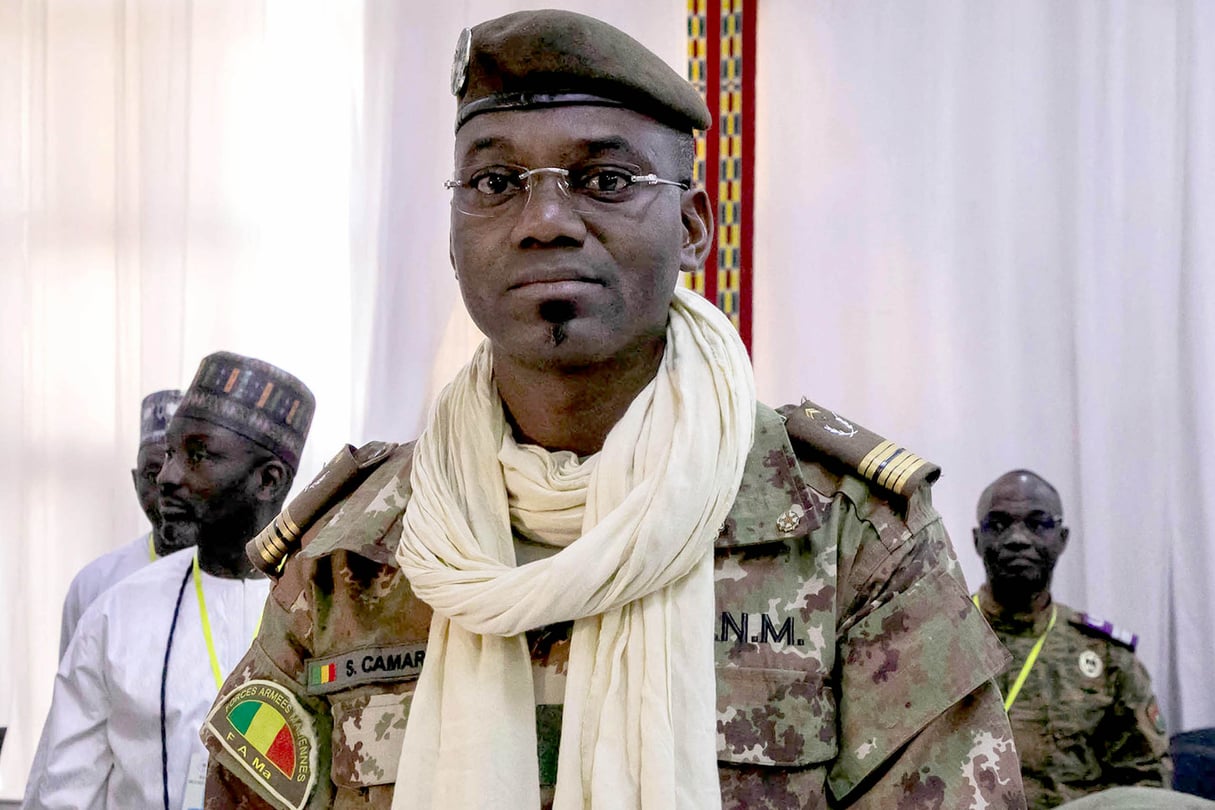
The general malien Sadio Camara. © FANNY NOARO-KABRE/AFP
The ruling junta announced two days of national mourning on Sunday, April 26, confirming the death of Mali's Defense Minister. Sadio Camara was killed at his residence in Kati, near Bamako, during attacks on April 25. The Tuareg rebellion, supported by jihadist groups, fully controls the city of Kidal in northern Mali. Following negotiations, Malian soldiers and Russian members of the Afrika Korps left the city for Gao. Civilian authorities also departed.
Key takeaways:
► The ruling junta in Mali confirmed on the evening of April 26 the death of Defense Minister Sadio Camara in attacks carried out jointly the previous day by jihadists from the Group for the Support of Islam and Muslims (JNIM), affiliated with al-Qaeda, and the Tuareg separatist movement, the Azawad Liberation Front (FLA). The attacks targeted strategic junta positions in Kati, near Bamako, where the minister was killed, as well as in Mopti and Sévaré in the center of the country and in Kidal in the north.
► The junta claims to have killed 200 "terrorists" and states that the attacks targeted seven locations in total: Bamako and Kati, near the capital; Konna, Mopti, and Sévaré in the center of the country; and Gao and Kidal in the north. The Chief of the General Staff of the Armed Forces described the situation as "very tense on April 25th" and referred to "a vast and complex destabilization plan," while asserting that the attackers had been repelled.
► The city of Kidal, in the north of the country, is also under the complete control of the JNIM jihadists and the Tuareg rebel group, the FLA. Following negotiations, the Russian mercenaries of Afrika Korps and the Malian army left Kidal for Gao, as did the official civilian authorities. The junta speaks of a repositioning outside of Kidal, thus acknowledging its withdrawal.
